Exploring the Stanford Ethics Toolkit for "Kulturdialog" art gallery and cultural program
By Regan King
A deliverable for the Stanford Ethics, Technology and Public Policy, Fall 2025 training cohort
Introduction
Worldwide we are becoming more and more isolated and fragmented, finding less opportunities to have creative interactions that generate dialogue, understanding, and meaning. News about global conflicts and impacts numb our senses and appetites to explore creative forms of dialogue outside our own social bubbles.
A group of friends spread across the globe found common interest in growing a space where modern Middle Eastern art meets the West in dialogue. A strategic interpretive program should center unique cultures, historical eras, and artistic genres in meaningful gallery events.
The 40-year friendship of the gallery co-founders, Mir Ali Hassanzadeh and Regan King, started on the steps of a Hamburg, Germany art school and continues today but separated by half the Earth's circumference. Ali, creator of the award winning multi-media installation “Adam’s Cube” and Regan, a civil servant with the State of California, exemplify the gallery's purpose in their mutual exploration of the never-ending storytelling of art in dialog.
By establishing an ethical vision and framework for the gallery, they hope to sustainably curate interpretive programs that host novel, inspirational artists who create new meaning at the crossroads of cultures.
The Stanford Ethics Toolkit provided methods that support the mutual exploration of impacts as part of the gallery's North Star.
Mission
To redefine human meaning, creativity, and culture in the age of AI by bridging tradition and modernity, fostering a global environment where art is the universal language for human expression, empathy, and transformation.
Vision
Our vision is to create a living dialogue among global cultures—a platform that reimagines the narrative of the Middle East, portraying its diversity, intellectual depth, and beauty to the world. By showcasing contemporary and traditional perspectives, the gallery and program will promote a new image of the region grounded in creativity, inclusivity, and peace.
Core Values and Principles
Using the toolkit workshop facilitated by Manuela Travaglianti, we identify the following gallery and program core values (in alpha order):
- Creativity
- Dialogue
- Dignity
- Empathy
- Justice
- Kindness
- Mindfulness
- Privacy
- Relationships
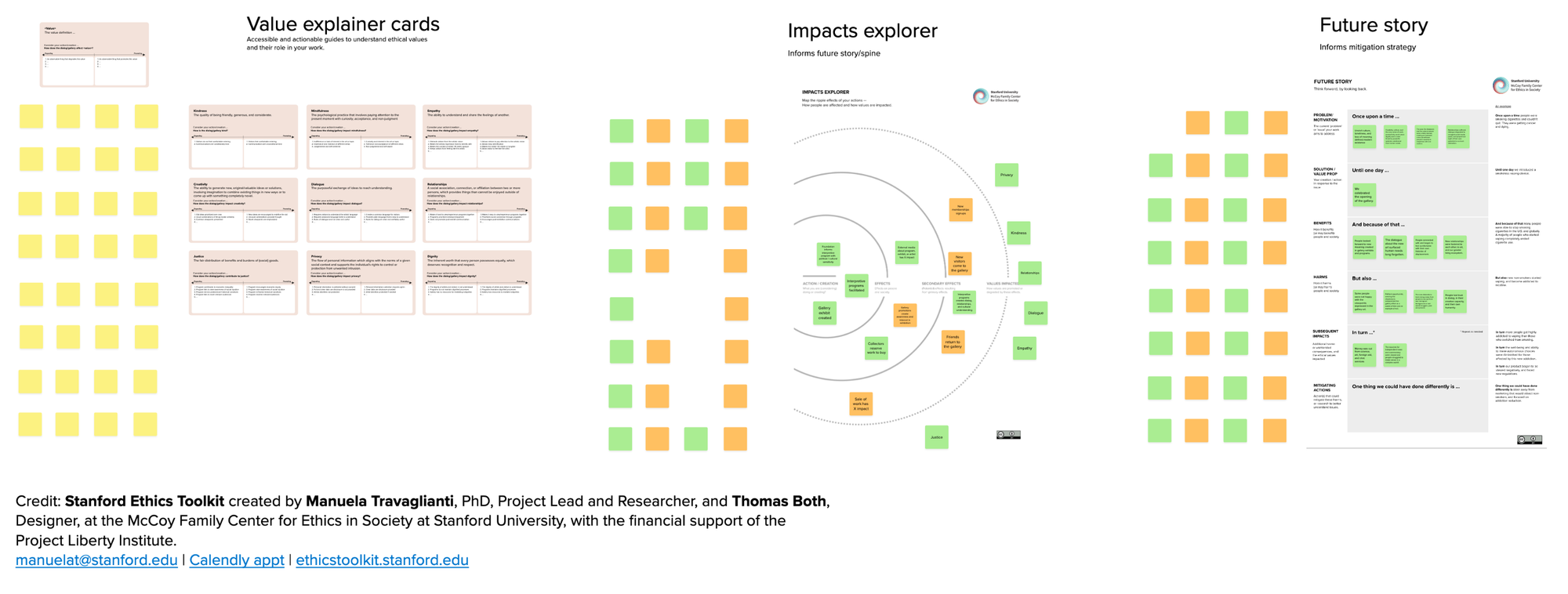
Using the values explainer cards tool, we defined the above values and configured opposing pairs of "degrading" and "promoting" observations that will inform gallery and interpretive program decisions.
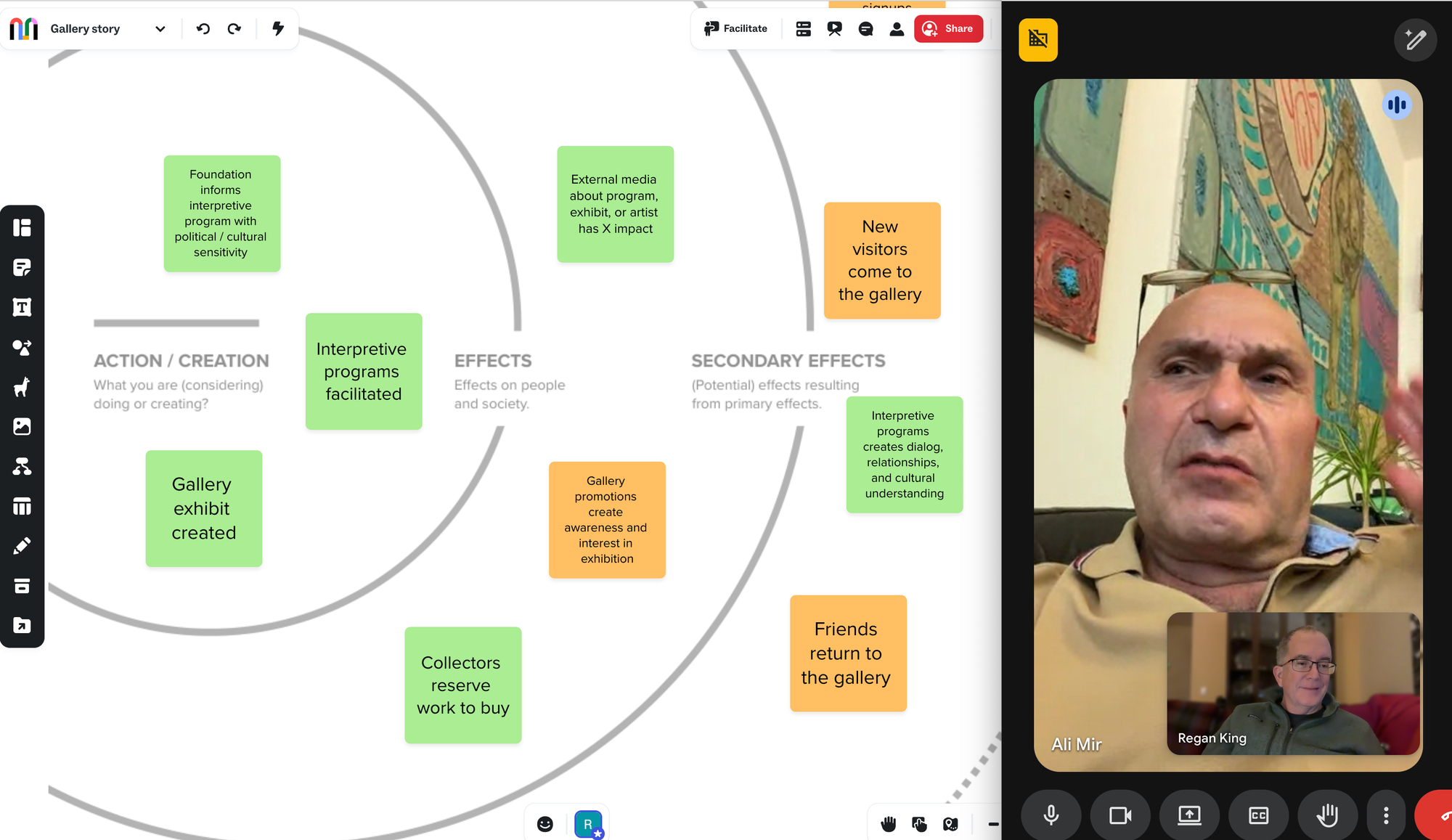
Using the impacts explorer tool, we mapped gallery functions (exhibits, interpretive programs, and foundation cultural liaisons), their first- and second-order effects, and impacted values.
Using the future story (or story spine) tool we created a look-back narrative from our ideal gallery future. This allowed us to frame the problem, the solution, the benefits, the harms, other impacts, and mitigating actions in a simple clear narrative.
Similar strategic business tools, like SWOT (Strengths, Weaknesses, Opportunities, and Threats), pale in comparison to the imaginative value of the collaborative toolkit. We hope that gallery and program stakeholders using the tool will make more transparent and ethically-driven decisions, adding value to the promotion of artists as well as to supporting members and institutions.
Application
We will not completely implement the toolkit for the dialog/art gallery by Nov 7th, 2025, the deadline for this final deliverable.
Ali and Regan have chosen and used the impacts explorer, future story, and value explainer cards for supporting decisions about establishing the gallery.
Current activities include:
- Advisor consultations
- Business plan development
- 5 year plan development
- First exhibit and interpretive program plan
- Negotiations with a partner gallery space donor
The first exhibit will have the theme “Rewriting Modernity” which will spotlight an artist's encounter with East/West cultural topics and dialogue with gallery visitors.
Stanford and interested persons can sign up here to receive gallery notification and future newsletters.
Key Learnings
The initial impression of one gallery founding participant was “This is the mind of the gallery!” This indicates that the toolkit has been useful for considering the effects of different actions on the core values of the effort. Especially the interactive character of the toolkit Mural platform underscores the dynamic quality of the tool for planning with multiple participants.
Without the toolkit we would not have considered:
- Having an ethical perspective for the gallery interpretive program at all
- Exploring nuances of ethical impacts
- Actions degrading and promoting values
- First- and second-order effects of actions
- Creating a future story as a guiding narrative
Although we’re not currently using it, the weighing options tool will come in handy especially when changing direction on an action and wanting to openly discuss the changing value priorities (if any). I envision this method significantly streamlining deliberations between multiple stakeholders who have agreed on the gallery values.
In addition to exploring use of the Toolkit for the gallery's ethical program, comparative research was conducted to create the necessary context for evaluating the Toolkit for use in a GovTech, human-centered civic design context. We believe the generative, collaborative value of the Toolkit is uniquely valuable.
Conclusion
Moving forward, I plan on ...
- A co-creator facilitated gallery workshop with the international gallery founders and advisors
- Further socializing the use of the toolkit, with consideration of toolkit best-fit determined in comparative research
- Promoting the value of the tool as a generative, collaborative process
- Contributing to a community of practice for the use of ethical toolkits in civic design / GovTech
Special note: I would like to express my heartfelt thanks to Manuela Travaglianti, Thomas Both, the McCoy Family Center for Ethics in Society at Stanford University, and the Project Liberty Institute for supporting and funding the Stanford Ethics Toolkit.